
Creating the Wendling Beck landscape masterplan
Wendling Beck is a pioneering landscape-scale nature recovery project restoring almost 2,000 acres of Norfolk countryside from intensive arable farming into a rich mosaic of high-distinctiveness habitats.
Designed to deliver measurable gains for nature, water, carbon and communities, the project is financed through Biodiversity Net Gain (BNG) and nutrient neutrality, demonstrating how large-scale ecological restoration can be delivered through innovative environmental markets.
Working alongside a world-class partnership — including The Nature Conservancy (TNC), Natural England, Norfolk Wildlife Trust, Norfolk Rivers Trust, Norfolk County Council, Anglian Water, Norfolk FWAG and the University of East Anglia — we developed a strategic landscape vision to align stakeholders around an ambitious long-term goal: restoring a thriving, resilient landscape for the future.
The resulting masterplan, designed by Digg & Co, provides a bold blueprint for landscape-scale restoration and collective action.
A Landscape Ready for Recovery
Wendling Beck brings together four neighbouring landholdings that were previously managed as around 1,500 acres of intensive arable and horticultural farmland.
Despite decades of intensive farming, the landscape retained a powerful ecological asset: a natural corridor along the Wendling Beck chalk stream, with pockets of wet woodland, scrub and wetland habitat.
This living river corridor — which includes three Sites of Special Scientific Interest (SSSIs) — forms the ecological backbone of the project and provides the foundation on which the wider landscape restoration is being built.
Wendling Beck chalk stream, from which the project takes its name, flows from Dereham in the south to Gressenhall in the north, feeding into the River Wensum — one of the most important chalk river systems in the world.
Chalk streams are globally rare, with the majority found in England. Protecting and restoring the Wendling Beck therefore contributes to safeguarding one of the planet’s most unique freshwater ecosystems.
Designing a Landscape for Nature and Climate
Creating the masterplan was a deeply collaborative process combining science, local knowledge and long-term vision.
The work began with targeted stakeholder engagement, followed by extensive research into the landscape’s ecological history and future potential. Historic habitats, lost ponds, hedgerows, water pathways and soil conditions were all analysed to understand how the landscape could function at its ecological best.
Working closely with ecologists eCountability, we developed a detailed ecological masterplan. This was supported by natural capital accounting by eftec, ecosystem services modelling and financial planning to ensure the landscape could generate sustainable long-term funding.
The goal was simple but ambitious: design a landscape that maximises ecological recovery while remaining economically viable and deliverable.
The masterplan draws on a wide evidence base, including:
Historic maps dating back to the late 1700s, revealing lost habitats and watercourses
Species surveys, LiDAR, geology, soils and hydrology data
Baseline measurement of ecosystem services
Drone imagery and satellite mapping
First-hand land knowledge combined with extensive ground-truthing surveys
The Wendling Beck Landscape Vision
Completed in September 2020, the Wendling Beck Landscape Masterplan sets out one of the most ambitious habitat restoration programmes in England.
The plan is now actively being delivered across the site and will create:
~900 acres of high-distinctiveness species-rich grassland
100 acres of new woodland
Dozens of new ponds
Tens of thousands of new trees
~20 km of new hedgerows
~5 km of restored river channels
~200 acres of heathland and scrub
~100 acres of wetland habitat
Together, these habitats will transform the landscape into a thriving ecological network, supporting wildlife recovery while improving water quality, storing carbon, and building resilience to climate change.
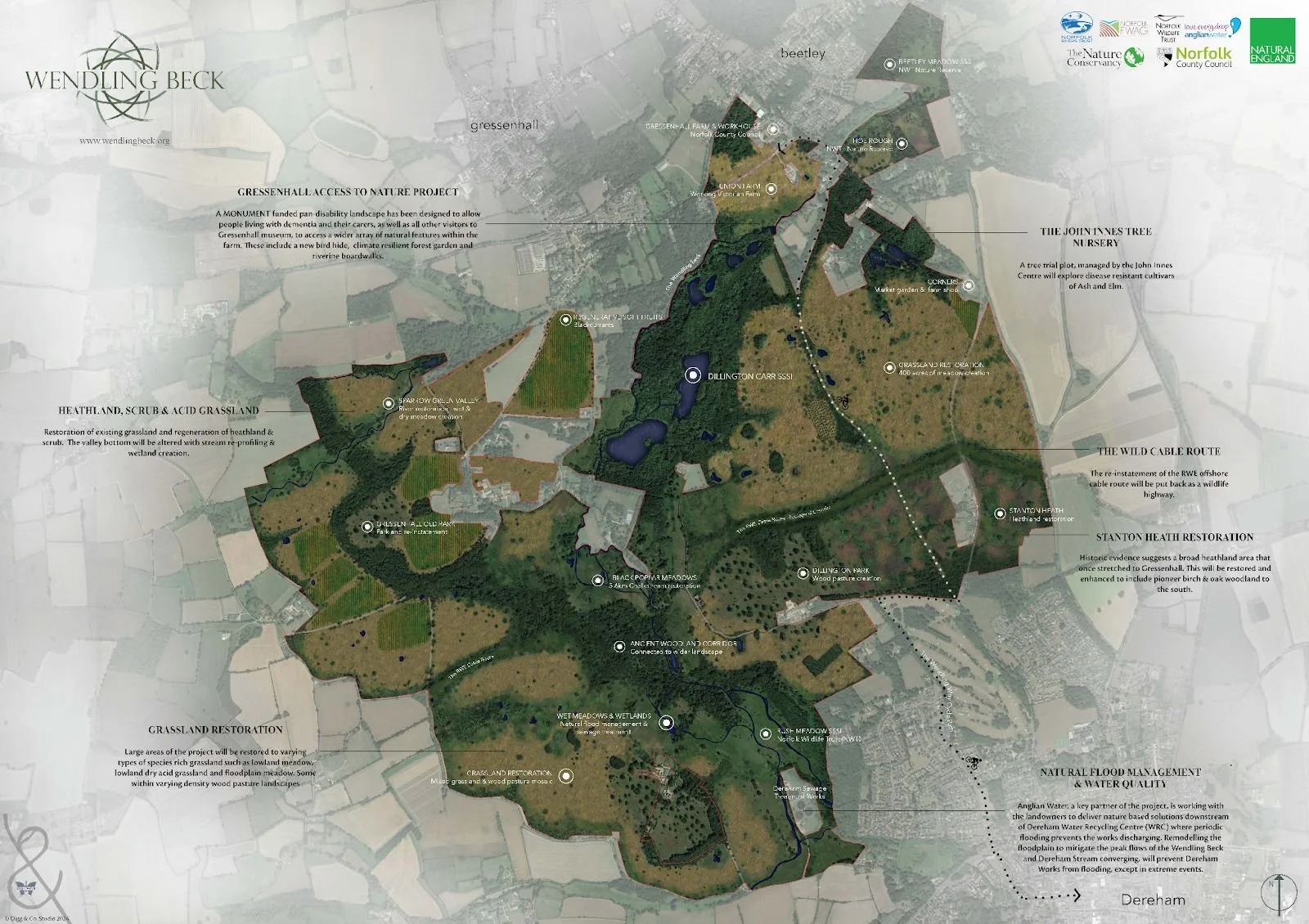
The masterplan combines detailed ecological data with landscape-scale design to identify where and how restoration will deliver the greatest ecological and hydrological benefits across the landscape.
By layering ecological surveys, hydrology, historic land use and natural capital modelling, the plan pinpoints the optimal locations for habitat creation, water management and species recovery — ensuring every intervention contributes to a coherent, functioning landscape.
Beyond habitat creation, the masterplan also sets out a wider vision for how Wendling Beck will transform the landscape over the coming decades. This includes:
Connecting fragmented habitats and linking SSSI sites, creating a large-scale ecological network where wildlife can move, recover and thrive
Restoring lost landscape features and heritage, including historic hedgerows, ponds and natural watercourses
Delivering natural flood management, slowing the flow of water through wetlands, ponds and restored river channels
Capturing and filtering agricultural runoff, helping to improve groundwater recharge and downstream water quality
Supporting species recovery and increasing biodiversity abundance across the landscape
Improving public access and strengthening connections with local communities, creating opportunities for people to experience and engage with a recovering landscape
Together, these goals ensure that Wendling Beck is not only restoring habitats, but rebuilding a resilient, living landscape that works for nature, climate and people.
To learn more about Wendling Beck’s ecosystem services, see our Biodiversity Net Gain and Nutrient Neutrality services.
